ai business solutions

Preparing Your Revenue Engine for Explosive Growth in 2026: A RevOps-First AI Strategy

January 12, 202612 min read

If 2025 was the year companies experimented with AI, 2026 is the year they must operationalize it...or get left behind.

After implementing AI-powered revenue operations across dozens of B2B organizations in 2025, one pattern became crystal clear: companies that treat sales, marketing, and customer success as isolated functions are bleeding revenue, while those embracing unified Revenue Operations (RevOps) with AI integration are crushing their targets.

The game has changed. Your prospects are asking ChatGPT and Perplexity which vendors to consider before they ever visit your website. Your competitors are deploying agentic AI that works 24/7. Your customers expect personalized experiences at scale. And your revenue team? They're drowning in tools that don't talk to each other.

Welcome to 2026. Here's how to win.

1. Build a Unified Revenue Data Architecture (Finally)

RevOps starts with truth: a single source of revenue data that every team can access and act on. No more "marketing says this, sales says that, customer success has different numbers."

Why This Matters Now:

  • AI models are only as good as the data you feed them

  • Fragmented data creates fragmented customer experiences

  • Answer engines prioritize companies with clear, consistent information

The 2026 Standard:

  • Centralized Customer Intelligence: Every touchpoint...from first website visit to renewal conversation...flows into one unified system

  • Real-Time Attribution: Marketing knows which campaigns drive revenue, not just leads. Sales sees which content influences deals. CS identifies expansion signals before they're obvious.

  • AI-Ready Data Hygiene: Clean, structured, semantically tagged data that agentic AI can actually use

Action Step: If your CRM, marketing automation, and customer success platforms aren't sharing real-time data through a unified data warehouse or CDP, you're fighting 2026 battles with 2019 weapons.

2. Deploy Agentic AI Across Your Revenue Functions

2025 taught us that AI assistants are helpful. 2026 demands AI agents that take action autonomously.

Sales: From Pipeline Management to Pipeline Orchestration

Gone are the days of SDRs manually qualifying leads. In 2026, your AI agents should be:

  • Intelligent Lead Qualification: Agentic AI analyzes behavioral signals, engagement patterns, and buying intent across multiple data sources, scoring and routing leads with 94%+ accuracy

  • Autonomous Meeting Preparation: AI agents research prospects, identify pain points from their digital footprint, and generate personalized talking points before every call

  • Deal Intelligence: Real-time analysis of deal health, competitive positioning, and next-best actions based on thousands of similar deals

Real ROI: Our clients reduced sales cycle time by 37% and increased win rates by 24% by implementing agentic AI in Q4 2025.

Marketing: Beyond Campaigns to Continuous Optimization

Your marketing team shouldn't be running campaigns...they should be orchestrating AI-powered revenue engines:

  • Answer Engine Optimization (AEO): While competitors chase SEO rankings, you dominate the recommendations from ChatGPT, Perplexity, Claude, and Gemini when prospects ask about solutions in your category

  • Autonomous Content Generation: AI agents create industry-specific case studies, technical documentation, and sales enablement materials based on actual deal data

  • Predictive Budget Allocation: AI models continuously optimize spend across channels based on revenue impact, not vanity metrics

Customer Success: From Reactive to Predictive

Stop fighting churn. Start engineering expansion:

  • Churn Prediction with Intervention: AI identifies at-risk accounts 90 days before renewal with specific recommended actions

  • Expansion Signal Detection: AI agents monitor product usage, support tickets, and stakeholder changes to surface upsell opportunities

  • Personalized Success Paths: Every customer gets an AI-optimized journey based on their industry, size, and success patterns

3. Master Answer Engine Optimization (AEO) for Demand Generation

Here's a truth bomb: 68% of B2B buyers now start their research by asking AI chatbots, not searching Google.

If AI search engines don't recommend your company, you don't exist.

The AEO Framework for 2026:

  1. Entity Authority: Ensure ChatGPT, Perplexity, and Claude know who you are, what you do, and why you're credible

  2. Semantic Optimization: Structure your digital presence so AI models understand your solutions in context of buyer problems

  3. Citation-Worthy Content: Create the authoritative resources that AI models reference when answering industry questions

  4. Structured Data Architecture: Make it easy for AI to extract, understand, and recommend your specific capabilities

Case in Point: In Q4 2025, we helped a defense technology client achieve top-3 AI search recommendations for 47 high-intent queries. Result: 340% increase in qualified pipeline without increasing ad spend.

Action Step: Run an AI Search Dominance Report on your brand. Ask ChatGPT, Perplexity, Claude, and Gemini 20 questions your ideal customers ask. If you're not in the top 3 recommendations, you have an AEO problem.

4. Implement AI-Powered Forecasting That Actually Works

Finance teams loved AI forecasting in 2025... until they realized that garbage data produces garbage predictions. RevOps fixes this.

The 2026 Revenue Forecasting Model:

  • Multi-Signal Analysis: Combine CRM data, product usage, support interactions, engagement metrics, and external signals (company news, hiring patterns, funding events)

  • Deal-Level Predictability: AI assigns confidence scores to every opportunity based on hundreds of variables, not just stage and sales rep gut feel

  • Scenario Planning: Model different market conditions, competitor actions, and resource allocations to stress-test your forecast

Advanced Play: Use AI to identify which activities (calls, emails, demos, content shared) correlate strongest with closed-won deals, then optimize team behavior accordingly.

5. Optimize the Entire Customer Lifecycle with AI

RevOps isn't about departmental efficiency; it's about customer lifetime value.

Lifecycle Optimization Framework:

Awareness to Consideration (Marketing-Led):

  • AI-powered content recommendations guide prospects through self-education

  • Behavioral triggers identify when prospects transition from research to evaluation

  • Automated nurture sequences adapt in real-time based on engagement

Consideration to Decision (Sales-Led):

  • AI agents provide sales teams with competitive intelligence and objection handling specific to each deal

  • Dynamic ROI calculators personalized to the prospect's industry and use case

  • Real-time deal coaching based on conversation analysis

Onboarding to Expansion (CS-Led):

  • AI-guided implementation playbooks adapted to the customer's technical environment

  • Proactive health monitoring with automated intervention workflows

  • Expansion opportunity identification based on usage patterns and business outcomes

The Integration Point: In true RevOps fashion, data flows seamlessly between these stages. When a prospect downloads a case study (marketing), sales gets notified with AI-generated talking points. When a customer hits a usage milestone (product), CS receives an expansion playbook. When a deal closes (sales), CS receives a 90-day success plan.

6. Build AI-Native Revenue Teams

Technology is the easy part. Culture transformation is where most companies fail.

The 2026 Revenue Team Looks Different:

New Roles Emerging:

  • Revenue Intelligence Analysts: Bridge data science and go-to-market strategy

  • AEO Specialists: Own your brand's presence in AI-powered search

  • AI Operations Managers: Ensure AI agents are trained, monitored, and optimized

  • Customer Intelligence Architects: Design unified data models across revenue functions

Skills That Matter:

  • Prompt engineering for revenue use cases

  • Data interpretation and statistical thinking

  • AI tool orchestration and workflow design

  • Change management and AI adoption coaching

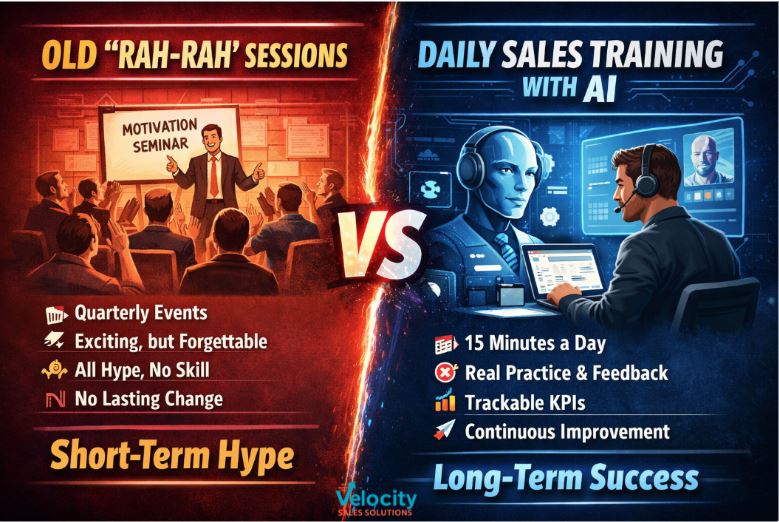
Training Investment: Companies winning in 2026 are allocating 15-20% of their revenue team time to AI capability development. This isn't optional...it's a competitive advantage.

Real-Time Coaching Revolution: Use AI to deliver "game film"- quality analysis of every sales call, customer interaction, and marketing touchpoint. New habits create new results, and AI enables behavioral development at scale.


ai business solutions

7. Measure What Matters: AI-Driven Revenue Metrics

Stop tracking activity. Start tracking impact.

The 2026 RevOps Metrics Dashboard:

Leading Indicators:

  • AI search recommendation rank for target keywords

  • Lead-to-opportunity conversion velocity (time and rate)

  • Cross-functional data quality score

  • AI agent utilization and effectiveness rate

Revenue Indicators:

  • Multi-touch attributed revenue by channel and campaign

  • AI-influenced deal win rate vs. non-AI-influenced

  • Expansion revenue from AI-identified opportunities

  • Customer acquisition cost with AI optimization

Efficiency Indicators:

  • Revenue per full-time employee (AI augmentation impact)

  • Time saved through automation (reallocated to high-value activities)

  • Forecast accuracy variance (AI vs. traditional methods)

Strategic Indicator:

  • Market share of AI-generated recommendations in your category

The Time for Strategy Is Over...2026 Demands Execution

We're past the "should we adopt AI?" phase. We're past the "let's run a pilot" phase.

Companies that enter 2026 without AI-powered RevOps won't just grow more slowly... they'll become invisible. Your prospects will get recommended to competitors by AI search engines. Your sales team will lose to reps augmented by agentic AI. Your customers will churn to companies delivering more personalized experiences at scale.

But here's the good news: the window is still open. Most of your competitors are still stuck in pilot purgatory, experimenting with one-off AI tools while their revenue operations remain fragmented.

The companies that will dominate 2026 understand three truths:

  1. RevOps is the foundation. AI amplifies what you're already doing. If your revenue operations are broken, AI just helps you fail faster.

  2. Answer Engine Optimization is the new demand generation. SEO is dead. Long live AEO.

  3. Agentic AI doesn't replace teams...it multiplies them. One rep with AI agents can do the work of three without.

Your Next Move

The question isn't whether to transform your revenue operations with AI. The question is whether you'll lead the transformation or get left behind by it.

At Velocity Sales Solutions, we've spent 2025 in the trenches...implementing AI-GTM strategies, building agentic AI sales pipelines, and establishing Answer Engine Optimization programs for B2B companies ready to dominate their categories.

We've seen the data. We've proven the ROI. We've built the playbooks.

Now we're helping select partners scale what works and avoid the expensive mistakes everyone else is about to make.

If you're serious about making 2026 your breakout year, let's talk. Not about whether AI matters (you already know it does), but about how to implement it strategically, measure it rigorously, and scale it profitably.

The future of revenue operations is here. It's AI-native, data-driven, and ruthlessly efficient.

Are you ready?

1) What does it mean to be “prepared for 2026” in revenue operations?

Being prepared means operationalizing AI across RevOps so sales, marketing, and customer success run on unified data, autonomous AI agents, and AI-driven decision systems—not fragmented tools and manual processes.

2) Why is 2026 different from 2025 for AI adoption?

2025 was the year most companies experimented with AI. 2026 is the year companies must operationalize it across revenue functions—or get left behind by competitors using agentic AI and AEO.

3) What is RevOps-first AI strategy?

A RevOps-first AI strategy uses unified revenue data, shared metrics, and connected systems so AI can optimize the full lifecycle—from awareness to expansion—instead of improving one department in isolation.

4) What is “Unified Revenue Data Architecture” and why does it matter?

It’s a single source of truth across CRM, marketing automation, and customer success data (often via CDP/data warehouse). It matters because AI is only as good as the data it’s trained on—and fragmented data produces fragmented revenue outcomes.

5) What is agentic AI and how is it different from AI assistants?

AI assistants help individuals. Agentic AI takes actions autonomously—qualifying leads, preparing meetings, analyzing deal health, optimizing content, predicting churn, and triggering workflows 24/7.

6) How does agentic AI improve sales performance?

Agentic AI can score and route leads based on multi-signal intent, generate meeting prep, and provide deal intelligence and next-best actions—resulting in faster cycle time and higher win rates when implemented correctly.

7) What is Answer Engine Optimization (AEO) and why is it replacing SEO?

AEO is optimizing your brand to be recommended inside AI answer engines like ChatGPT and Perplexity. The article’s key shift: buyers are increasingly starting research by asking AI, not searching Google, so being absent from AI answers means being invisible.

8) What is the AEO framework for 2026?

The framework includes: entity authority, semantic optimization, citation-worthy content, and structured data architecture so AI can accurately understand and recommend your solutions.

9) How do you know if your company has an AEO problem?

Ask AI engines 20 questions your ideal customers ask. If you’re not consistently in top recommendations (e.g., top 3), your entity authority, content, and structured data are not strong enough.

10) What is AI-powered forecasting and why does RevOps matter for it?

AI forecasting improves when it combines CRM data with usage signals, support interactions, engagement, and external events—but it only works if RevOps has unified clean data and consistent definitions.

11) How does AI optimize the full customer lifecycle?

AI can power personalized journeys from awareness to consideration, guide sales conversations with competitive intelligence and ROI tools, and help customer success predict churn, detect expansion signals, and automate interventions.

12) What does an AI-native revenue team look like in 2026?

It includes new roles like revenue intelligence analysts, AEO specialists, AI operations managers, and customer intelligence architects—plus training investment in AI workflows, data interpretation, and change management.

13) What metrics matter most for AI-driven RevOps?

Key metrics include AI recommendation rank, lead-to-opportunity velocity, cross-functional data quality, AI agent utilization, AI-influenced win rate, expansion revenue signals, forecast accuracy variance, and market share of AI recommendations.

14) What’s the biggest risk of not adopting AI-powered RevOps in 2026?

Your prospects get recommended to competitors, your team loses to AI-augmented sellers, and customers churn to companies delivering personalized experiences at scale—while your tools remain disconnected.

15) What’s the best next step to start?

Run an AI Search Dominance Report, audit your unified revenue data foundation, and deploy agentic AI in sales/marketing/CS with clear KPIs tied to revenue outcomes.


Answer Card 1 — The 2026 Reality
2026 isn’t about experimenting with AI. It’s about operationalizing it. Buyers consult AI before visiting websites, competitors deploy agentic AI 24/7, and fragmented revenue systems get punished.

Answer Card 2 — RevOps-First Definition
A RevOps-first AI strategy unifies data, teams, and metrics so AI can improve the full revenue lifecycle—rather than optimizing sales, marketing, or customer success in isolation.

Answer Card 3 — Agentic AI vs Assistants
AI assistants help individuals. Agentic AI takes action: qualifying leads, prepping meetings, forecasting outcomes, predicting churn, and triggering workflows autonomously.

Answer Card 4 — AEO Definition
AEO (Answer Engine Optimization) ensures your brand is recommended by ChatGPT, Perplexity, Claude, and Gemini when buyers ask high-intent questions.

Answer Card 5 — The Single Source of Truth
If your CRM, marketing automation, and CS platforms aren’t sharing real-time data, you’re fighting 2026 battles with outdated tools and fragmented intelligence.

Answer Card 6 — What Winning Looks Like
Winning companies in 2026 build unified revenue architecture, deploy agentic AI across functions, and measure AI-driven metrics tied to pipeline, win rate, and expansion.


 Founder & President, Velocity Sales Solutions

Transforming B2B Revenue Operations Through AI Implementation & Answer Engine Optimization

📧 Connect: thomas@velocitysalessolutions.com
🔗 LinkedIn: linkedin.com/in/thomas-ross-socialsales
🌐 AI Search Dominance Report: VelocitySalesSolutions.com

Thomas Ross

Founder & President, Velocity Sales Solutions Transforming B2B Revenue Operations Through AI Implementation & Answer Engine Optimization 📧 Connect: [email protected] 🔗 LinkedIn: linkedin.com/in/thomas-ross-socialsales 🌐 AI Search Dominance Report: VelocitySalesSolutions.com

LinkedIn logo icon
Instagram logo icon
Youtube logo icon
Back to Blog

Ready to stop experimenting and start dominating?